 Skip to content
A lab cleaning checklist only works when it’s split into contamination zones, timed to a real frequency schedule, and backed by a signature trail. Miss one of those three legs and you’re not maintaining a safe space, you are just mopping floors and hoping.
What’s Wrong With Most Lab Cleaning Checklists?
Same checklist, three different labs: a university research space, a biotech startup, a contract testing shop. Only the logo changes really. Wipe counters, empty trash, disinfect doorknobs. It’s like an office checklist wearing a lab coat, and it falls apart the moment real contamination risk shows up .
Take a night crew wiping an autoclave handle with the same rag that touched a fume hood sash ninety seconds earlier. Nobody caught it because the checklist never told them not to. That’s a checklist that was never built for a lab in the first place.
So, skip the extra bullet points. Build zones instead.
How Do You Actually Zone a Lab for Cleaning?
Zoning sorts tasks by contamination risk, not by which room they happen to sit in. A shared printer and a biosafety cabinet might be ten feet apart on the floor plan. On a checklist, they should be worlds apart.
Think of it in three rough bands. General areas cover floors, walls, and the break room nobody volunteers to clean. High-touch zones cover keyboards, shared devices, and door handles everyone grabs without thinking twice. Then there’s the band that actually matters most: biosafety cabinets, fume hoods, any bench where samples get handled directly.
Cross-contamination prevention isn’t a poster taped above the sink, though it usually ends up as one anyway. It’s the entire point of zoning, full stop. One cloth per zone. One EPA-approved disinfectant per zone. Costs next to nothing and saves you from a very uncomfortable phone call down the road.
What Belongs on a Daily vs. Weekly vs. Monthly Checklist?
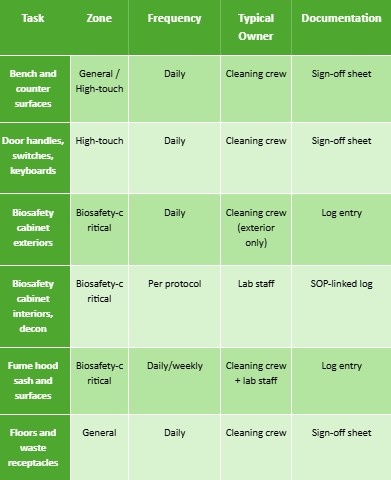
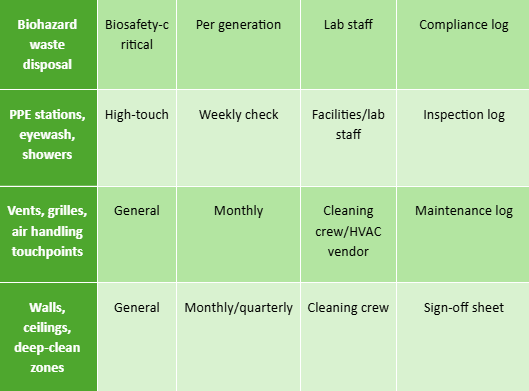
Frequency is where most checklists quietly fall apart, usually within a month of being printed. Somebody wipes the obvious stuff daily and forgets the vent grilles exist until an inspector points a flashlight straight at one. A real terminal cleaning schedule gets built around actual risk, not whatever habit the last hire happened to walk in with.
The Daily Non-Negotiables
Keep this list short on purpose. A checklist longer than a tired crew can finish in one shift just won’t get finished, period.
- Disinfect every high-touch surface with the correct zone-specific product.
- Sweep and mop floors, then let disinfectant sit for its full dwell time.
- Empty and sanitize trash receptacles, replace liners.
- Wipe biosafety cabinet exteriors only (interiors stay with trained staff).
- Log the task with initials and a timestamp before moving on.
The Stuff Everyone Forgets Until Audit Week
Vent grilles collect a startling amount of dust nobody thinks about between quarterly deep cleans. Chair casters roll straight through a reagent spill and track it to the next bench over, and nobody notices until a shoe sticks to the floor. Shared pen holders, the label dispenser, that one pair of scissors everybody borrows and nobody claims: touched by every hand in the building, cleaned by exactly none of them. A generic checklist skips all of it. An audit finding never does.
Why Does Documentation Matter More Than the Cleaning Itself?
Here’s the part nobody wants to hear: an inspector doesn’t actually care how clean your lab looks on a random Tuesday. They care whether you can prove it happened, with a timestamp, on demand. A spotless bench with no log behind it counts as unverified under OSHA lab standard, CAP expectations, and GLP compliance requirements alike, and unverified might as well be dirty.
Say an inspector pulls the log from six weeks back and finds a gap on a Wednesday. Doesn’t matter that the bench probably got wiped down anyway. The citation is for the missing signature, not the missing dust. Log every task, every time, or as far as the paperwork’s concerned, it never happened at all.
What Products and PPE Actually Belong in a Lab Cleaning Cart?
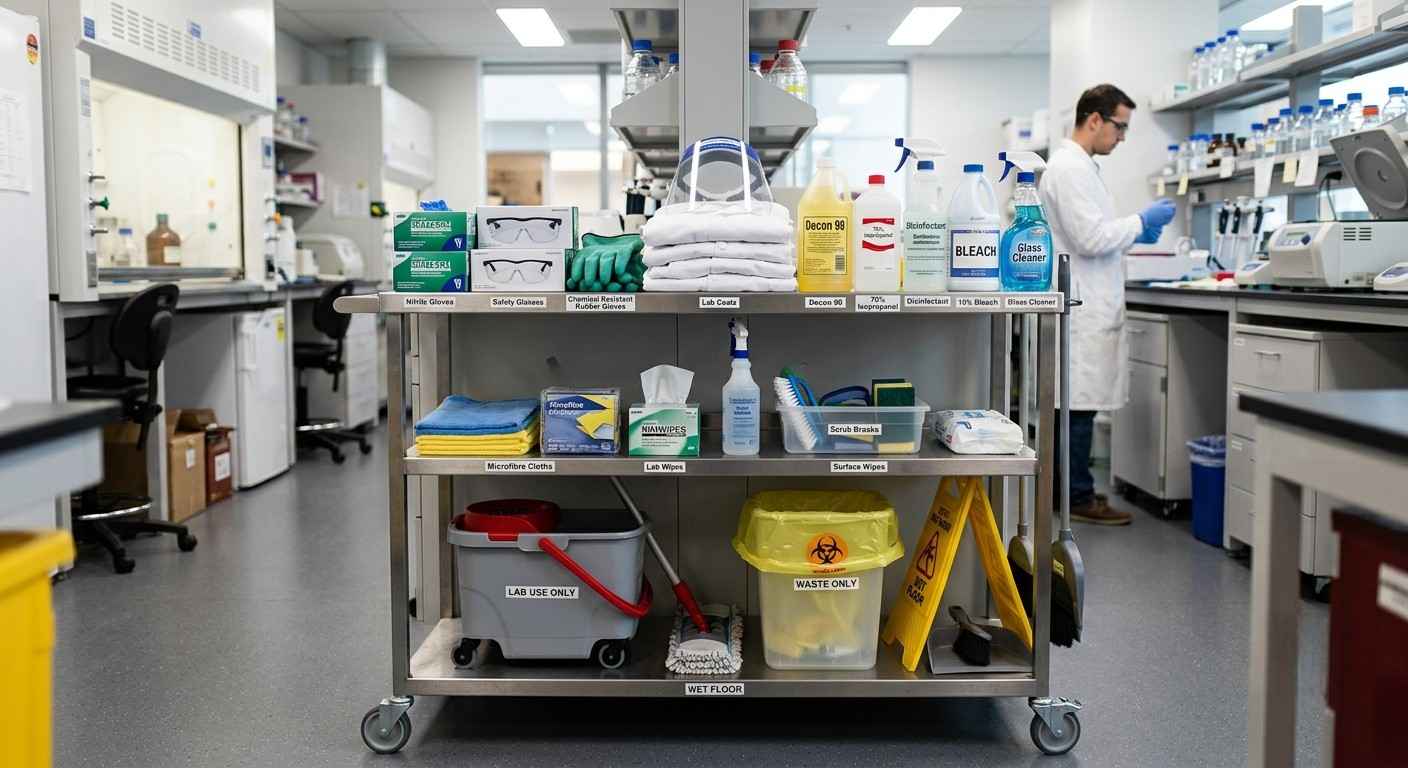
Not every disinfectant belongs in every zone, and this trips up more crews than anyone likes to admit. A quaternary ammonium compound that works fine on an office counter can be close to useless near a virology bench, where certain organisms barely notice it. Match the product to the actual pathogen risk of the zone. Don’t grab whatever’s cheapest by the case, because that call tends to look a lot worse in hindsight.
Dwell time matters just as much as which bottle you reach for. Spray it, wipe it off thirty seconds later, and you’ve cleaned basically nothing except your own conscience. Follow the manufacturer’s contact time, every single time, or skip spraying altogether. PPE works the same way. Gloves rated for general cleanup aren’t automatically rated for a biosafety-critical zone, so check the rating before you assume it, not after.
Where Do Most Cleaning Partnerships Break Down?
Right about here is where theory runs into payroll. A generalist janitorial crew, however hardworking, was trained to clean offices, not to think in terms of a laboratory disinfection protocol or zone-specific risk. Drop them into a lab without lab-specific onboarding and you’re gambling with your compliance record, whether anyone frames it that way out loud or not.
The labs that stay audit-ready long term work with a cleaning partner trained specifically for critical environments, not a generalist crew improvising with a mop bucket and good intentions. Worse still, most facilities only discover the gap after a failed inspection, right when fixing it gets expensive.
Stop Trusting a Sticky Note on the Fridge!
If your current checklist is a laminated page nobody’s touched since the last compliance cycle, you already know it isn’t working, not really. Build the zoned, tiered, documented version instead, or bring in a crew that already runs one.
Summity Cleaning Services works with labs and healthcare facilities that need protocol-driven cleaning built around real risk zones, not a generic janitorial routine stretched to fit. Get in touch and have a checklist built around your lab, not around a template pulled off the internet.
Frequently Asked Questions
Can janitorial staff clean inside a fume hood?
Generally, no. Interior fume hood work involves chemical residue risks best left to trained lab staff or certified technicians.
What's the biggest lab cleaning compliance mistake?
Missing documentation. Clean surfaces with no logged proof get treated as unverified during OSHA or CAP inspections.
Do all lab zones need the same disinfectant?
No. Match disinfectant chemistry to each zone's contamination risk instead of using one all-purpose product everywhere.
How do you choose a lab cleaning partner?
Look for critical-environment training, zone-specific protocols, and a documented compliance history, not just the lowest bid.
