 Skip to content
WELL Certification is the framework that basically proves a building really does protect the health of the people inside it, covering air quality, water, lighting, materials, movement and more. If you manage, own, or design commercial space, it’s the most credible method to show tenants and employees that you care about their wellbeing, not only your utility bill.
Here’s the thing nobody tells you at the start. Getting the plaque is easy compared to keeping it.
What Is WELL Certification?
The WELL Building Standard comes from the International WELL Building Institute, and it does something LEED never quite committed to. It measures people, not just performance data.
Ten concepts. Dozens of preconditions. A scoring system that rewards things most owners never think about, like whether lighting matches your circadian rhythm or a quiet room exists on a 40,000 square foot floor.
You don’t get WELL Certification for installing better windows. You get it for proving, with documentation and independent verification, that the humans inside your building are healthier because of choices you made.
That’s a much higher bar.
WELL vs. LEED: Why People Keep Mixing Them Up
They get lumped together constantly. Both involve consultants, both involve points, both look great on a leasing brochure.
But LEED cares about the building. Energy use, water conservation, site selection, materials sourcing. A LEED Platinum building can still have poor air circulation, harsh overhead lighting, and a break room nobody wants to sit in.
WELL cares about the occupant instead. Picture a solar powered, rainwater harvesting office tower where half the staff still gets headaches by 2 p.m. That building could ace LEED and fail WELL without breaking a sweat.
Look at it this way. LEED asks if the building is good for the planet. WELL asks if the building is good for you.
The Ten Concepts Nobody Reads Past Air and Light
Most articles list these and move on. But each one carries real teeth, not just good intentions.
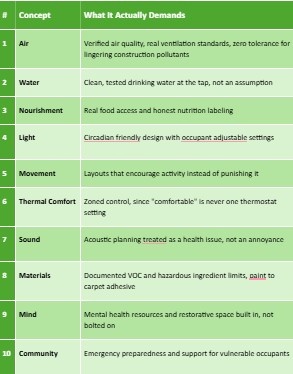
Skip any one of those and the whole certification wobbles. That’s kind of the point.
How the Certification Levels Work
Four tiers: Bronze, Silver, Gold, Platinum. Bronze needs 40 points and every precondition met. Silver bumps to 50 with at least one point per concept. Gold wants 60 and two points minimum across each.
Platinum sits at 80 points with three points minimum everywhere. Most buildings stall around Silver, not because the standard is unreasonable, but because follow through is harder than design intent.
Because that’s really the story here. Design gets you the points on paper. Operations keep you there.
Does It Actually Pay Off, or Is This Just Feel Good Marketing?
Fair question. Skeptics deserve real numbers, not vibes, and I get the skepticism.
WELL certified spaces command rental premiums of 4 to 7 percent over comparable uncertified buildings, with top tier projects pushing 10 to 15 percent in major metros. Indoor environmental quality tied to WELL requirements has also been linked to productivity gains of 8 to 11 percent. Run the math, and a productivity bump of even half a percent nets nearly 300 percent return on investment for a large corporate tenant.
Marketing? Sure, a little. But the underlying economics genuinely holds up.
Where Buildings Quietly Blow Their WELL Score
This is the part nobody puts on the brochure. Certification is a snapshot. Recertification, required every three years, is where buildings get caught out.
Air quality preconditions don’t maintain themselves. Neither does water system hygiene, or the materials protocols that were airtight at buildout and forgotten once the ribbon got cut. A team using the wrong cleaning chemicals can undo months of air quality work in one afternoon of overspray. Dust piling up in HVAC returns quietly, tanks scores nobody’s watching until the audit shows up.
Worse still, most owners find out about these gaps during recertification, not before that. That’s an expensive way to learn a lesson.
What’s New for 2026, and What Does It Cost?
IWBI opened enrollment for the WELL Real Estate Rating in January 2026, a lighter option focused on base building infrastructure. Think of it as a stepping stone toward full certification without committing everything up front.
Registration fees typically run $1,500 to $12,000 depending on project size, before consultant fees and the operational changes needed to actually earn the points. Budget for months, not weeks.
Your Building’s Air Quality Score Is Only as Good as Last Tuesday’s Cleaning Protocol
Here’s the uncomfortable truth: you can spend six figures on consultants, compliant materials, and circadian lighting, and still lose points because someone’s using the wrong disinfectant or letting dust build up in a vent nobody checks. Certification is kind of a moment in time but keeping it going is a daily discipline you live in those small details that most owners never really think to audit.
If you want that plaque to make it through its first recertification cycle, begin with a facility partner who actually gets what WELL asks for operationally, not just what it looks like on paper. Summity Cleaning Services teams up with property groups to keep indoor air quality, materials handling, and hygiene protocols lined up with WELL standards, long after the initial walkthrough fades out.
Frequently Asked Questions
Do you need LEED first before pursuing WELL?
No. They're independent standards. Many buildings pursue both, but neither requires the other.
How long does WELL Certification last?
Three years, then recertification is required along with updated performance documentation.
Can a single tenant space get certified, or only whole buildings?
Both. WELL offers certification paths for individual spaces, entire buildings, and even portfolios.
Who actually verifies compliance?
Independent assessors through Green Business Certification Inc. conduct onsite testing, not IWBI itself.
