 Skip to content
Autonomous floor scrubbers and UV disinfecting robots now handle the mindless grind of commercial cleaning at a fraction of standard labor cost. They run all night, letting your human crews tackle the sticky, complex details cleaning robots just can’t see. Honestly? This kind of night-shift automation is the only math that works today.
So Why Is Everyone Suddenly Buying Robots for Their Cleaning Crew?
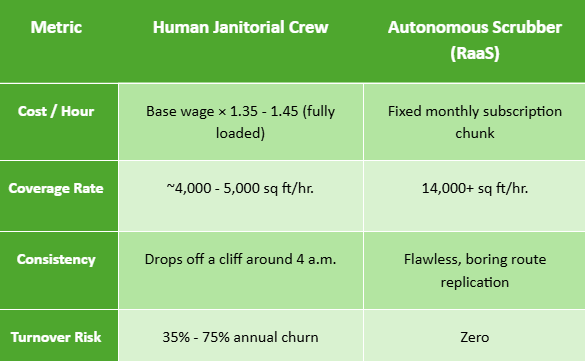
Finding people willing to clean commercial buildings in the middle of the night is absolutely miserable work right now. Facility managers aren’t dealing with a slight labor dip; they are fighting a structural collapse in the janitorial workforce. Industry turnover sits anywhere from 35% to 75% every single year. You aren’t just managing a team at that point. You are running a relentless, exhausting hiring factory just to keep the floors somewhat acceptable.
Then look at the money side of labor cost reduction. A $16 base wage is a fairy tale. Add payroll taxes, workers’ compensation, insurance, and the constant friction of onboarding people who just quit by text message. The true loaded cost of a human cleaner is always their hourly wage multiplied by 1.35 or 1.45.
The real kicker, and the reason for the boom, is robots-as-a-service (RaaS). A few years ago, commercial cleaning robots were terrifying capital investments. You had to pitch the CFO on a sixty-grand hardware purchase. Now? You basically lease the machine through a monthly operating expense. That is exactly “why now.” The financial barrier to entry vanished.
What Kind of Robot Are We Even Talking About?
Forget about that round plastic disk bumping into your couch at home. Industrial robotic cleaning services rely on heavy, expensive hardware built to take a beating:
- Autonomous floor scrubbers and vacuums: Huge rigs that drop water, scrub hard surfaces, and suck up the dirty slurry in one single pass.
- UV disinfection robots: Rolling light pillars built specifically to fry airborne hospital pathogens without using harsh chemicals.
- Window-cleaning units: Suction-heavy wall climbers for massive vertical glass panes.
Let’s Talk Numbers Because That’s What You Care About
People love discussing innovation at trade shows. But back in reality, facility budgets run on spreadsheets and cleaning automation ROI. Dropping one of these machines onto a shift offsets roughly one full-time equivalent (FTE) worker on the night shift. Here is exactly how the numbers stack up on the graveyard shift.
Where Robots Actually Save You Money (and Where They Don’t)
Do not go out and fire your staff. Seriously. Robots are incredibly stupid outside their narrow comfort zones.
They absolutely print money when you point them at large, unobstructed surfaces. Got 50,000 square feet of polished warehouse concrete? An empty airport terminal at midnight? A long, vacant school hallway? An autonomous scrubber will destroy that task and save you a fortune in man-hours.
But they absolutely bomb at the fine details. A $50,000 scrubber will happily roll right over a smashed piece of gum stuck to a mop pad and drag it across the tiles. It cannot clean the grout in a bathroom corner. And if some local contractor leaves that tangled orange extension cable just lying around across a doorway, the robot will grab it, get all entangled, then basically sit there beeping loudly into the dark, like completely done until some human rescues it. If you drop a robot into a messy and heavily used office area, with swivel chairs, clutter, and trash bins everywhere, you will end up spending a lot more time watching the machine, than it ever saves you.
Is This Actually Changing the Industry, or Just Another Vacuum With a Marketing Budget?
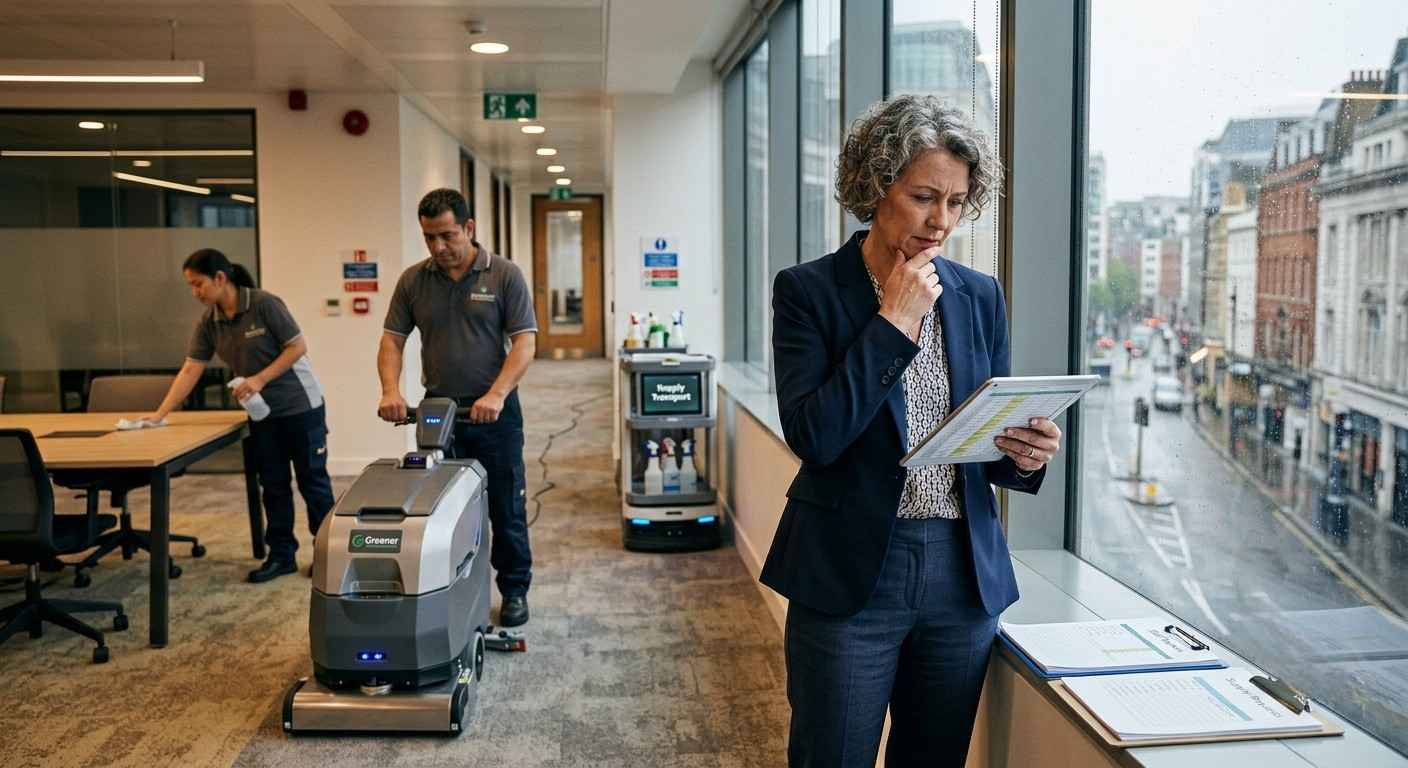
It is a permanent structural shift. The old human-only model is slowly dying, making way for the new standard: hybrid human-robot crews.
Healthcare networks and massive retail chains jumped in first because they have the sheer square footage and crushing hygiene standards to justify it. But the technology finally caught up to the marketing hype. Thanks to cheap sensor fusion and vastly improved LiDAR navigation, these things aren’t blind anymore. They actively “see” the environment, rerouting around a late-night shelf stocker instead of blindly ramming into them.
Plus, the massive financial shift from giant capital buys to RaaS subscription pricing changed everything for the middle market. Now regional property managers can afford a piece of the action.
What This Means If You Manage a Building, Not a Robotics Startup
As a facility manager, you don’t need a degree in facility management technology. You need a highly practical filter to cut through the sales pitches.
Look down at your floors. If you have wide-open corridors, massive hard floors, and a solid dead-zone overnight with zero foot traffic, you need to pull the trigger. It’s a no-brainer. But if you run a labyrinth of densely packed, fully carpeted cubicles? Don’t worry. The juice isn’t worth the squeeze.
And seriously, do not buy the hardware outright if you can help it. Partner up with a managed service. You want a local cleaning contractor who brings both the humans and the robots together in one package. Let their guys handle the tedious route mapping, the busted sensors, and the annoying firmware updates. You don’t want to manage a robot fleet. You just want the floors clean.
Fix Your Night Shift Before It Breaks!
Stop letting your operations budget bleed out on constant hiring and training for shifts nobody actually wants to work anyway. You can either keep fighting a losing battle against endless turnover, or you can automate the dead weight and put your people where they actually make a noticeable difference in your building.
Challenge your current setup, run the brutal math on your floor plan, and reach out to Summity Cleaning Services to finally get your nightly overhead under control.
Frequently Asked Questions
Do these things crash into walls or people?
Not anymore. They use advanced LiDAR to map the space in real-time, smoothly driving around pallets, carts, and late-night staff.
Do I have to buy the machine upfront?
Rarely. Most managers use a subscription model (RaaS), paying a flat monthly fee instead of a massive, painful initial equipment purchase.
Is setting them up a total nightmare?
A technician drives it manually around your building exactly once to map the route. After that, it runs entirely on autopilot.
Who fixes the machine when it breaks?
If you use a managed cleaning service, they handle all the maintenance. Your onsite team just empties the dirty water tank.
